Predicting support for Official Development Assistance
Scientists have been studying and generalising human behaviour for well over a century and it’s fair to say that human beings are predictable.
The emergence of psychology as a discipline in the late 19th century distinguished the study of our thoughts and behaviours as a science. Rather than an offshoot of philosophy, it was recognised that understanding the human mind required a scientific method more closely related to physiology.
Modern scientists study human behaviour and mental processes in both neural and cultural terms, and for a variety of reasons. The findings of their research has been used to understand our needs, motivations and roles in society, our habits (electoral and other), as well as improve our mental and physical health.
Dawn of the Mad Men

Since the middle of the twentieth century, the study of human behaviour has been used in another way: to sell products like Coca-Cola and jeans (even cigarettes). Corporations saw an opportunity to increase profit margins by using advertising to nudge audiences into changing their behaviours. They began to influence our shopping habits by using behavioural science to predict what sort of things would motivate us to spend our money.
Changing behaviours for better health outcomes
During this time, and perhaps in response to this, academics also started to take more interest in using human predictability to promote health outcomes. Publicly-funded health services, like that in the UK, have an economic interest in keeping their populations healthy. The power of human predictability has allowed our health services to nudge us towards being generally healthier people: by drinking or smoking less, eating more vegetables, exercising more.

By developing impactful advertising campaigns to keep us healthy, the NHS realised it could spend less money on the social, physical and economic interventions required to fix a population that is chronically sick. Much of the same logic is applied when rich countries provide funding for healthcare interventions in poor countries: as well as addressing the moral imperative of redressing historical inequities caused by colonialism, keeping individuals healthy enough to go to work is considerably more cost-effective than looking after a population that can’t work at all.
With that in mind, we wanted to understand more about what predicts support among populations for government assistance being spent in low-income countries. Especially during times of economic crises (hat tip: cost of living crisis) we know that many individuals begin to look more domestically in how their taxes are being spent.
So what does influence support for Official Development Assistance (ODA)?
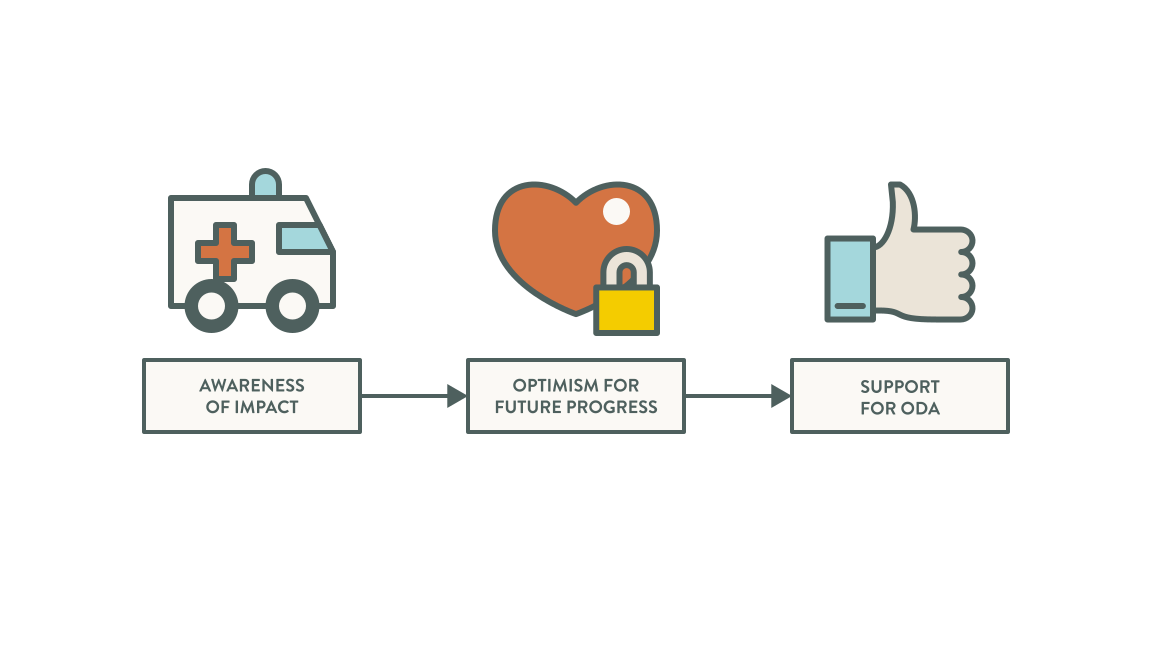
We wanted to test a hypothesis we’d heard from multiple colleagues over the years which proposed that an awareness of the impact made by aid expenditure in the past (A) could influence people’s optimism that future progress was possible (B), which could influence people to support government money being spent on it (C).
We were keen to test this hypothesis alongside a number of other possible motivators of support. Education, political identification, age, gender, ethnicity – all these demographics are known to influence our perceptions in one way or another. As do our values, so we wanted a way to test these too. Although they are harder to define, the study of human behaviour has found that humans are primarily driven by certain values sets. These include benevolence, universalism, hedonism, self-direction, and conformity. In the late 20th Century, Shalom H. Schwarz developed a replicable method (one which works consistently again and again in different contexts) to define and test our basic values, so we wanted to include those too.

To find out how these things interact with support for aid expenditure, we surveyed representative (online) samples of around 2,000 people in four countries: the US, UK, India and South Africa. We asked questions to understand more about how people view the world, how they understand progress (both past and future) on a range of issues, and whether they support existing taxpayer-funded efforts to continue to intervene. We did this using focaldata’s self-serve research platform, so while the results skew slightly wealthier, more educated, and more urban (particularly in India and South Africa, where internet penetration is lower), the results are broadly representative of an engaged public who would be more likely to see digital content designed to change their views.
The research indicated that, perhaps unsurprisingly, support for aid is not evenly distributed across the four countries surveyed. India is the most supportive, followed by South Africa. The United States and the United Kingdom show about the same levels of support and opposition to aid expenditure as each other, but levels of support are far lower than India and South Africa (though the US and UK are still more likely to support aid, rather than oppose it). Countries that have benefited from aid expenditure (and indeed countries which have been harmed by colonialism) are more likely to support wealthy countries spending money on aid. But what else did we learn about those who live in rich countries, and their support for ODA?
Rich countries and support for ODA
The primary observation was that there is a predictive link between support for Official Development Assistance (ODA) and perceptions of past and future progress, but the link between progress and support is too weak to suggest that there is a causal relationship. Instead, the data suggests that individual values, along with the perceived efficacy of aid programmes, appear to be more strongly predictive of support for aid.

As with other research over the last few years which has looked at social or political attitudes, we can also see that personal values matter: valuing “benevolence” (wanting to help others) increases support for ODA across all four countries and, in the US and UK, valuing “security” (protecting social order) decreases support for ODA.
Interestingly, the strongest predictors of support for ODA across all countries are whether the respondent perceives aid to be effective at solving problems. Emphasising how aid money is spent, its impact on global problems, perhaps even transparency and accountability; these could all be effective in building support for ODA. Maybe we could show more clearly the link between health interventions, healthy populations, and our ability to work (and in turn create more wealth for our country). So in a way, past impact does matter. It’s perhaps less neat than demonstrating “progress”, but rather requires a lengthier story to demonstrate “effectiveness” through more logical reporting of the impact of aid.
To summarise what we found
- There are some predictive links between perceptions of past progress, belief in future progress, and support for ODA, but these links are complicated (non-linear) and nuanced, and vary by market.
- Perceptions of past progress makes little difference across markets. Optimism about future progress on different issues (e.g. optimism about a reduction in poverty, or increased access to healthcare) present predictive, but weak, relationships in different markets.
- The UK’s support for aid is not linked to past or future progress at all, but is more strongly predicted by individual characteristics (attitudinal and demographic markers).
- Some seemingly positive attitudes and views inversely affect support for aid. Namely, believing that childhood rates of mortality will decrease over the next 15 years is associated with a decrease in support for overseas development aid among respondents in both the United States and South Africa.
- Non-white people across the US, UK and South Africa are more likely to support aid, along with more educated people in the UK. Religious people are more likely to support aid in the UK, South Africa and India, but not in the US. Older people are less likely to support aid in the US, UK and South Africa.
- The US is the only market in which optimism about future progress (specifically as it relates to poverty alleviation) has a stronger predictive link to support for aid expenditure than a person’s broader characteristics.
- In the US, in fact, optimism about future progress reducing childhood mortality predicts a decline in support for ODA.
So while there is a link between optimism and support, it’s not always in the expected direction, and there are other factors which better explain support for aid.

Trust in institutions matters
Believing that aid is effective, valuing helping others, believing governments can make a difference in the world, and having previously donated money to international development charities are all much stronger predictors of aid support. What these findings could speak to, in a general sense, might be trust in institutions. Longitudinal studies over the past few years (including the often-cited Edelman Trust Barometer) show trust in institutions – including government, media, international organisations and others – to be at an all time low. Yet, general trust in our governments to make a difference, trust in the charities we donate to, trust in others (to the extent that we perceive value in helping our fellow citizens) might be the key to understanding where support for aid really comes from.
If trust in institutions were to increase, perhaps we’d see support for aid expenditure increase too. Maybe this is something we can test again. Perhaps a new hypothesis should seek to understand more about what predicts perceptions of aid efficacy and trust?
And yes, maybe impact stories have a place here. But so do values and organisational motivations: bringing organisations to life in a way that demonstrates who they are. Making the people doing the work more visible, showing why they choose to do it, how their work benefits all of us, and how the logic of aid spending results in real stories of societies improved. Perhaps we need to move away from corporate branding and instead show who we are. Because if humans are predictable, we’re probably much easier to trust.